


2026 Palisade Hybrid Winter Driving: HTRAC AWD, Lake Effect, and Cold-Weather MPG
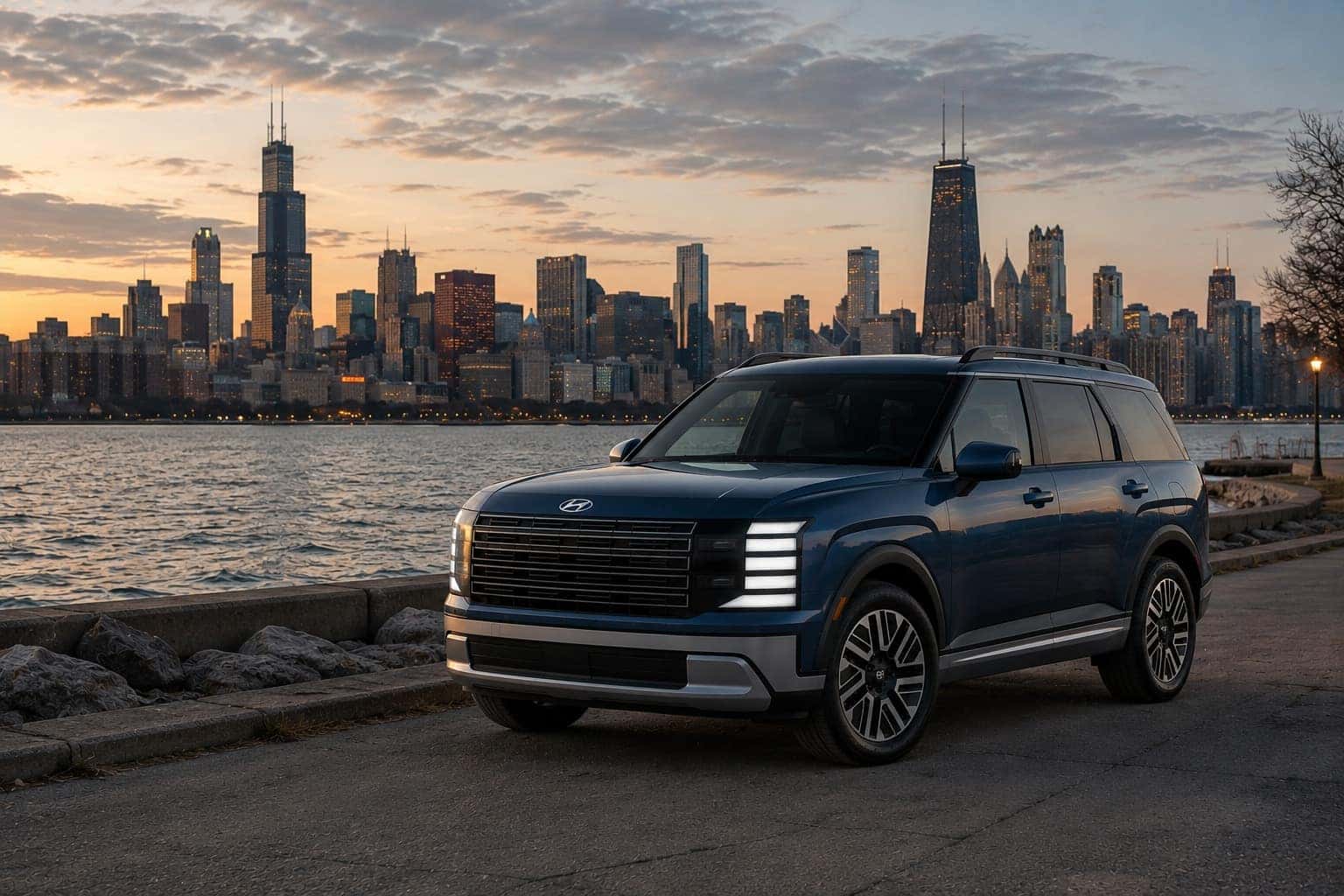
Winter Driving Guide
2026 Palisade Hybrid Winter Driving: HTRAC AWD, Lake Effect, and Cold-Weather MPG
What to expect when the snow comes off Lake Michigan. Practical winter guidance for Hammond, Munster, and Calumet City families from Webb Hyundai Highland.
Last updated: May 12, 2026 · Cold-weather guidance from Webb Hyundai Highland service team
Quick Answer
The 2026 Hyundai Palisade Hybrid handles Northwest Indiana winters well with HTRAC AWD (standard on Blue SEL Premium, available on every other trim), Snow / Mud / Sand terrain modes on SEL Premium and above, and instant electric torque that aids low-traction launches. Expect a 3 to 5 MPG drop in real-world efficiency below 20°F, recovering by April.
In This Guide
How does HTRAC AWD work on the Palisade Hybrid?
HTRAC is Hyundai’s active all-wheel-drive system. It defaults to front-wheel drive on dry pavement for efficiency, then engages the rear axle electronically when sensors detect wheel slip, cornering load, or driver demand for traction. The system can shift up to 50 percent of available torque to the rear axle within milliseconds.
On the Palisade Hybrid, HTRAC is standard on the Blue SEL Premium trim. On SEL, Limited, and Calligraphy, HTRAC AWD is available as a paid option over the standard FWD configuration. There is no AWD-only trim and no FWD-only trim, with the single exception of Blue SEL Premium where AWD is standard.
Beyond basic AWD, SEL Premium and above add a terrain mode selector with Snow, Mud, and Sand presets. The Snow mode softens throttle response, smooths shift points, and biases torque distribution to maintain stability rather than maximize traction at any one wheel. Snow mode is the right setting for plowed but icy roads, which describes most Highland-area conditions from December through February.
Do you actually need AWD in Highland and the surrounding area?
Honest answer: probably not, if you commute on plowed major roads and park in a garage. Most Highland and Munster residential streets get plowed within 6 to 12 hours of a snowfall. The Borman and I-65 are cleared continuously. Indianapolis Boulevard, US-30, and 41 are state-priority routes. For these roads, FWD with a good set of dedicated winter tires beats AWD with all-season tires by a measurable margin in stopping distance and lateral grip.
The case for AWD strengthens in three scenarios:
- You park outside on a hill or grade. The starting traction on an unplowed driveway is where AWD genuinely earns its cost.
- You commute through Calumet City, Hammond, or Whiting overnight and early morning. The wind-blown drift patterns near the lakefront create patches of unplowed accumulation between sweeps.
- You travel north through Cook County or up to Wisconsin in winter. Roads outside the immediate Highland area aren’t cleared at the same rate.
If none of those apply, consider FWD with winter tires. The MPG and price difference often comes out to $1,500 to $2,500 over five years of ownership in fuel and AWD service costs. Winter tires for the Palisade Hybrid run $900 to $1,300 installed, and you keep them for 4 to 5 winters.
From Our Highland Service Bay
The common Highland-area buyer mistake is choosing AWD as insurance against a single bad storm a year, when winter tires on FWD would actually have prevented more incidents over a typical season. We’ll mount and store winter tires for you in our service center, which makes the seasonal swap painless.
What MPG will you actually see in winter?
EPA estimates are run at moderate temperatures. Real-world winter MPG drops on every hybrid because three things happen below 30°F:
- The hybrid battery delivers less power output until it reaches operating temperature.
- The gas engine runs more often (and longer) to maintain cabin heat, which removes the hybrid’s biggest fuel-saving advantage.
- Air density and tire rolling resistance both increase, which raises baseline fuel demand.
For Highland-area drivers, here’s a realistic real-world range across the year:
| Condition | Typical Real-World MPG (FWD Blue SEL) |
|---|---|
| EPA estimate | 34 combined |
| Spring / fall (40 to 70°F) | 33 to 36 |
| Summer (warm, A/C running) | 31 to 34 |
| Mild winter (20 to 40°F) | 28 to 31 |
| Deep cold (below 20°F) | 25 to 29 |
Ranges from Hyundai owner data and real-world reports. Your numbers will vary with driving habits and trip length.
Short trips suffer more than long trips in winter. A 4-mile commute from Munster to Highland in 15°F weather may average 22 to 24 MPG because the hybrid system never fully warms up. The same vehicle on a 60-mile highway run from Highland to Indianapolis at the same temperature will return 28 to 31 MPG. Plan your commute pattern accordingly if MPG is a priority.
How does it handle lake-effect snow and Borman commuting?
Lake-effect snow off Lake Michigan is its own weather pattern. Bands of intense snow develop quickly, drop 2 to 8 inches in 2 to 4 hours, then shift. Hammond, Whiting, and parts of Munster get hit harder than Highland in many events because of the proximity to the lake and wind direction.
For lake-effect specifically, three Palisade Hybrid traits help:
- Instant electric torque aids smooth low-speed launches in fresh snow without wheel spin, which the gas Palisade can do but less elegantly.
- HTRAC’s stability-first programming in Snow mode prioritizes keeping the vehicle straight over maximizing acceleration, which matters in actual lake-effect conditions.
- Built-in Dash Cam (Calligraphy standard, optional elsewhere) records the road for insurance purposes when conditions deteriorate fast.
For Borman Expressway commuters running into Chicago in winter, the Palisade Hybrid has another advantage: stop-and-go traffic in the cold is precisely where the hybrid system shines. The engine cycles off at stops, the electric motor handles low-speed creep, and you save fuel that a gas Palisade or non-hybrid SUV burns idle. The MPG advantage actually widens in winter rush-hour traffic compared to summer highway cruising.
How to prep your Palisade Hybrid for a Northwest Indiana winter
- Install dedicated winter tires in November, before the first hard freeze. Mount them on a second set of wheels if you can; mounting and dismounting tires on the same rims every season wears the bead seal.
- Check the 12-volt accessory battery at our service center. The hybrid battery powers the drivetrain, but a separate 12-volt battery runs accessories and the start system. Cold weakens 12-volt batteries faster than people expect.
- Top off coolant and washer fluid with winter-grade washer formula rated to at least -25°F.
- Use the cabin pre-conditioning via Bluelink. Warming the cabin and battery preserves real-world range and reduces cold-start fuel penalty.
- Park in a garage when possible. Even an unheated garage holds the vehicle 10 to 15 degrees warmer than the street, which meaningfully improves hybrid efficiency on the first drive of the morning.
- Schedule a tire rotation at the 6,000-mile mark if you’ve been running winter tires. Even AWD systems benefit from rotation patterns to keep tire wear even.
From Our Highland Service Team
The single most common winter Palisade Hybrid issue we see in our Highland service bay is a weak 12-volt accessory battery. The hybrid is engineered conservatively and will alert you, but it’s a cheap and easy item to check at your normal service visit. Drop in any time before December and we’ll test it for free.
Key takeaways
- HTRAC AWD is available on every trim, standard on Blue SEL Premium
- Snow / Mud / Sand terrain modes start on SEL Premium
- Expect 25 to 29 MPG below 20°F, recovering to 33 to 36 MPG in spring
- FWD with winter tires often beats AWD with all-season tires for most Highland-area driving
- Instant electric torque aids low-traction launches and stop-and-go winter commuting
- 12-volt accessory battery is the #1 winter Palisade Hybrid service item
Frequently asked questions
Does the hybrid battery lose range in cold weather?
Yes. Hybrid batteries deliver less power output and the gas engine runs more often to maintain cabin heat. Expect a 3 to 6 MPG real-world drop below 20°F. The battery itself is fine, this is normal physics across every hybrid.
Is HTRAC AWD worth the upgrade?
Worth it if you park outside, drive unplowed roads regularly, or commute toward Cook County. Skip it if you commute on plowed major roads and can fit winter tires into your budget. Many Highland buyers come out ahead with FWD plus winter tires.
Can I pre-heat the cabin remotely?
Yes. Use the Hyundai Bluelink app on your phone to start the climate system 5 to 10 minutes before you leave. This warms the cabin, defrosts windows, and preconditions the hybrid battery for better efficiency.
Do I need to plug in the Palisade Hybrid in winter?
No. The Palisade Hybrid is a self-charging hybrid. There’s no plug. Cabin pre-heat runs off the 12-volt battery and gas engine, not external power.
What winter tires do you recommend?
For 18-inch wheels on SEL and SEL Premium: Bridgestone Blizzak WS90 or Michelin X-Ice Snow. For 20-inch Limited: same brands in 255/50 R20. For 21-inch Calligraphy: limited winter tire selection at that size, consider dropping to a 20-inch winter wheel and tire setup.
Does the Palisade Hybrid have heated seats and steering wheel?
Heated front and second-row seats plus heated steering wheel are standard starting on SEL Premium. Heated third-row seats are added on Limited and Calligraphy. SEL does not include any heated seats as standard.
Get winter-ready with our Highland service team
0 comment(s) so far on 2026 Palisade Hybrid Winter Driving: HTRAC AWD, Lake Effect, and Cold-Weather MPG